<!– SEO CHANGE LOG 1. Added keyword "tilt-shift lens" to the H1. 2. Added keyword "tilt-shift lens" to the intro body copy. 3. Added keywords "tilt", "shift", and "tilt-shift lens" to the early explainer paragraph. 4. Changed H2 "Why bother using a tilt-shift lens for portraits?" to "Why use a tilt-shift lens for portraits?" to keep the keyword tighter. 5. Changed H2 "What “tilt” actually does" to "What tilt does to focus and depth of field" to add "depth of field". 6. Changed H2 "What “shift” does, and why it is probably the more useful half" to "What shift does, and why the shift feature is often more useful" to add "shift feature". 7. Changed H2 "Why this look works so well in an urban portrait” to “Why tilt-shift photography works so well in an urban portrait” to add “tilt-shift photography. 8. Added keywords “plane of focus” and “focal plane” to the tilt explanation. 9. Added keywords “vertical lines”, “converging lines”, and “perspective correction” to the shift explanation. 10. Added keyword “aperture” to the practical explanation of how tilt changes sharpness. 11. Added keyword “24mm tilt-shift lens” to the equipment reference already in the copy. 12. Added keyword “normal lens” to the comparison copy where it already fit naturally. 13. Added keyword “photographer” to the audience-facing line about what people care about. 14. Added keyword “field of view” to the shift section. 15. Added keyword “tilt and shift lenses” to the “right for every portrait?” section. 16. Added keyword “using a tilt shift lens” to the FAQ. 17. Added keywords “tilt-shift lens”, “shift lens”, “tilt shift photography”, “plane of focus”, “depth of field”, and “vertical lines” to image title attributes. 18. Added keyword-rich alt text to the lead image and gallery images while keeping descriptions readable. 19. Added one light location mention, “Leeds”, in the urban portrait section. 20. Added one restrained service term, “portrait photographer”, to the final CTA without turning it into brochure copy. –>
Tilt-shift lens portraits: a less ordinary way to shoot people
Most portraits are shot the obvious way. Normal lens, normal blur, normal perspective, job done. Fair enough. But every now and then it is worth breaking out something a bit more bonkers.
This shoot with Andy Taylor-Boucock was one of those days. I’d actually brought the 24mm tilt-shift lens for architecture work, but once we started walking and looking at locations, it became pretty obvious it could do something interesting for portraits too.
The short version is this: tilt can give you a very unusual plane of focus and depth of field, while shift lets you frame a person against buildings and strong lines without everything looking like it is falling over backwards. Used carefully, a tilt-shift lens gives portraits a look that feels cleaner, stranger and a bit less generic than the standard location setup.

Why use a tilt-shift lens for portraits?
Good question, because they are not exactly the first thing most people reach for when photographing a person. They are slower to use, fully manual, and a bit fiddly compared with a normal lens. So there has to be a point.
The point here is not to be weird for the sake of it. It is to get one of three things.
- Cleaner lines in the background, especially around buildings and urban locations
- A different kind of depth and separation from what a normal lens gives you
- Portraits that feel a bit more considered and a bit less samey
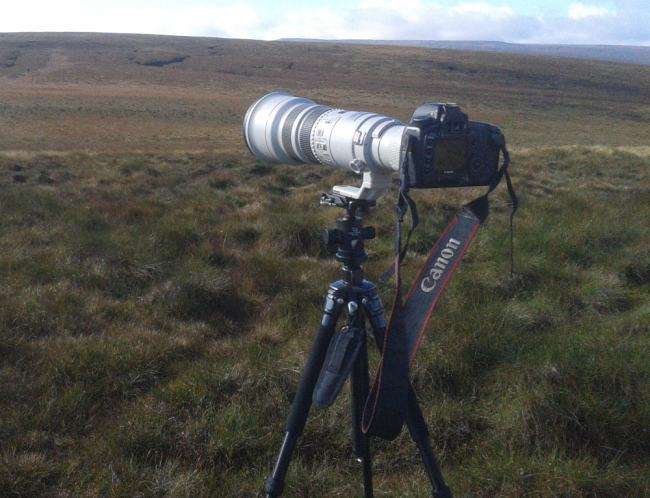
That last bit matters more than the lens itself, really. Nobody outside photography circles cares what chunk of metal and glass I had bolted to the camera. They care whether the photograph looks cracking or not, and whether the photographer has used the right tool for the job.
What tilt does to focus and depth of field
Tilt changes the angle of the plane of focus. That sounds a bit geeky, but stick with me. On a normal lens, the sharp bit of the image tends to sit in a fairly predictable flat zone. With tilt, that sharp zone can be angled through the frame, shifting the focal plane in a way a regular lens cannot.
So instead of “face sharp, background blurry” in the usual way, you can get a diagonal slice of sharpness, or a narrower band of focus, with blur falling away in a much stranger pattern. Depending on the aperture and how much you tilt the lens, the plane of focus can cut through the frame in a way that feels subtle or properly odd. That is why some of these frames feel a bit off-kilter in a good way.
It is not a look I would use on every portrait session. Use it all the time and it starts feeling like a party trick. Use it on the right shot, though, and it gives you something a normal lens simply does not.
What shift does, and why the shift feature is often more useful
Shift is the bit that often makes more practical sense in portraits.
Normally, if you want to include more of a tall building or more foreground around a person, you tilt the camera. That works, but the moment you do that, vertical lines start leaning and converging lines become more obvious. Buildings begin to look like they are toppling over, which is not always ideal unless your model is standing in front of something that actually is falling down.
Shift lets me keep the camera level, so the verticals stay properly vertical, and then move the lens to reframe the shot. In plain English: I can include more of Andy and more of the surroundings without making the architecture look wonky. It is basically a very handy form of perspective correction, and it lets me change the field of view within the frame without pointing the camera all over the place.
For environmental portraits, especially in cities, that is massively useful. You get cleaner geometry, stronger composition, and a frame that looks more intentional.
Why tilt-shift photography works so well in an urban portrait
Urban locations can be brilliant for portraits, but they do come with a problem: there is often a lot going on. Railings, kerbs, windows, brickwork, signs, lamp posts, all the usual visual chaos.
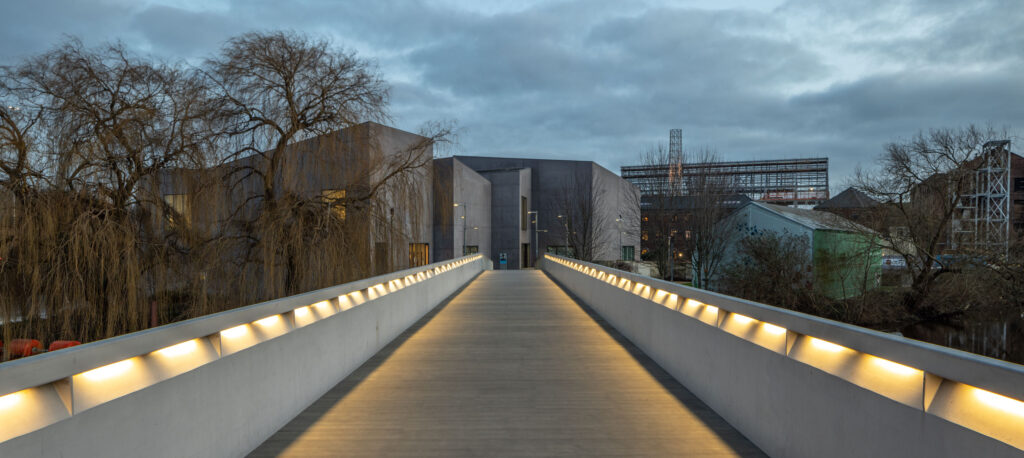
Tilt-shift photography gives you a bit more control over that chaos. Firstly, shift keeps the structure of the place looking right. Secondly, tilt can pull the viewer’s eye toward the person in a less obvious way than just smashing the background into mush with a fast telephoto. Thirdly, the whole thing feels a bit more architectural, which suited this walk nicely around Leeds.
That was part of the fun here. Andy has the sort of look that can carry a more fashion-ish frame, but the locations still mattered. The lens let both things exist together instead of one murdering the other.
How the light was handled
This was natural light rather than my usual flash-heavy setup. We were on a lockdown walk, travelling light, so the trick was really just reading the light carefully and not fighting it.
Quite a few frames were bracketed two stops apart so I had one exposure protecting that lovely blue sky and another giving me safer exposure on Andy. In other shots, I kept him in shade against a much brighter background. Later on, when the sun played nicely, I angled him so it worked as a rim light. Same basic rule as flash, really: if you cannot move the light, move the person and move yourself.
Is a tilt-shift lens right for every portrait?
Nope. And that is half the point.
Tilt and shift lenses work best when the background has lines, shape or architecture worth preserving, and when you want a frame to feel a bit more unusual without going full circus. If the location is visually weak, or if the brief just needs fast, straightforward headshots, a normal lens is often the better tool.
So this is not me saying, “Right, everybody needs a tilt-shift lens now.” It is more that, on the right subject and in the right place, it can produce portraits with more shape and character than the bland standard approach.
A few quick questions people usually ask
Does it make portraits look fake?
No. Or at least, it doesn’t have to. Used badly, yes, it can look gimmicky. Used carefully, it just gives the frame a different feel.
Is tilt the same as the fake miniature look?
That effect comes from the same general principle, but using a tilt shift lens in portraits is a different beast. Here it is more about directing attention and changing how focus sits through the frame.
Is shift only useful for architecture?
Not at all. It is brilliant in portraits where you want the person and the location to work together without bending the background lines all over the shop.
Would I use this on every shoot?
Definitely not. It is one option in the bag, not a religion.
Want the technical rabbit hole?
If you fancy the more nuts-and-bolts version, I’ve written a few related posts already.
- Tilt-shift explainer blog
- More on tilt and depth of field
- Architecture examples using shift
- The lens itself over on WEX
What to look for in the photos below
Before you dive into the gallery, keep an eye out for four things: frames where the sharpness cuts through the image in an unusual way, shots where the buildings stay properly upright, natural-light images with bright sky held under control, and the last few frames where I’d switched over to the 70-200 for a different feel.
In other words, this is not one trick repeated twenty times. There are a few different ideas at work here.
Here are the photos


A final thought
Tilt-shift lenses are not everyday portrait kit, and that is precisely why they can be fun. They slow you down a bit, make you think harder about composition, and occasionally give you something a normal setup simply would not have handed over.
For me, this shoot was a good reminder that some of the best ideas arrive when you bring one lens for one job, then ignore your own plan and try the harebrained option instead.
So there you go.
If you fancy more portrait and personal-branding work, have a look around the rest of the site, or get in touch here if you’ve got a shoot in mind and want a portrait photographer who doesn’t mind the occasional oddball idea.